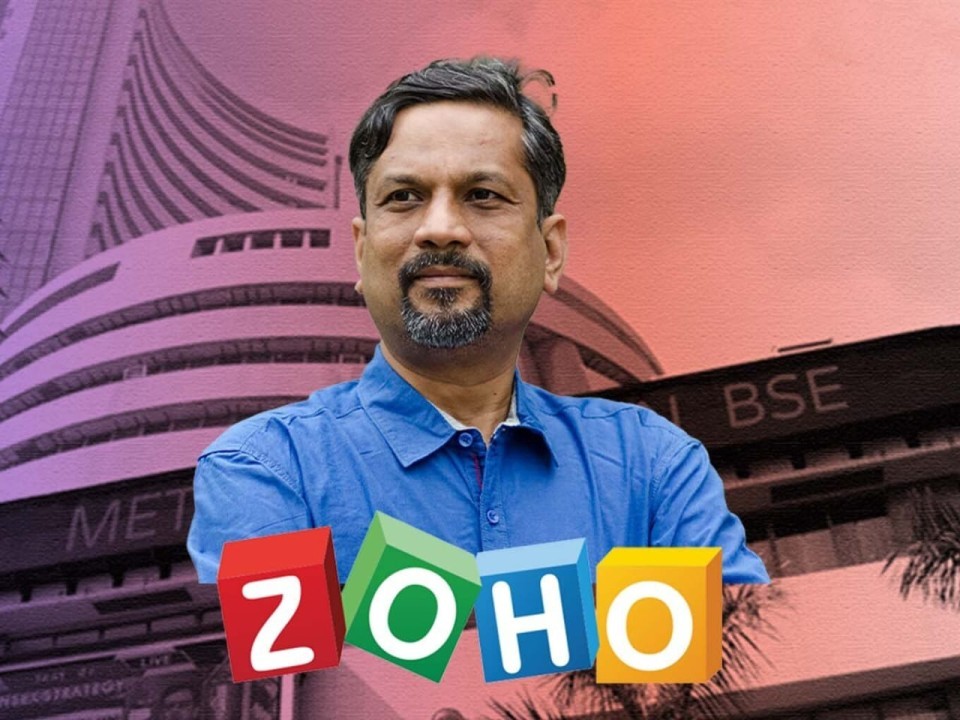
In the flashy world of Silicon Valley, where tech CEOs compete over luxury lifestyles and media attention, Sridhar Vembu stands as a refreshing anomaly. Born in 1968 in a small village in Thanjavur district, Tamil Nadu, this soft-spoken engineer has built a $5.85 billion empire while maintaining his humble roots and authentic leadership style.
Unlike his contemporaries who chase venture capital and IPO valuations, Vembu has created something far more valuable: a sustainable, profitable technology company that serves over 10 crore users worldwide without compromising its values or independence. His journey from a village in Tamil Nadu to becoming one of India’s most respected tech leaders represents a masterclass in patient entrepreneurship and principled business building.
What makes Vembu truly exceptional isn’t just his net worth of $5.85 billion as of 2024, but his unwavering commitment to building technology that genuinely helps businesses thrive. His recognition with the Padma Shri in 2021 and appointment to India’s National Security Advisory Board validates his contribution beyond mere financial success.

Academic Excellence Meets Entrepreneurial Vision
Vembu’s intellectual foundation was built through rigorous academic training that would later inform his approach to technology and business. After completing his bachelor’s degree in electrical engineering from the prestigious Indian Institute of Technology, Madras, he pursued a Ph.D. from Princeton University, one of the world’s leading institutions for advanced research.
However, the conventional academic path couldn’t contain his entrepreneurial spirit. After earning his Ph.D., Vembu briefly took up a teaching position in Australia but returned after just two weeks, realizing that his true calling lay elsewhere. This pivotal moment demonstrated his willingness to abandon security for the uncertain but exciting world of technology entrepreneurship.
His career began at Qualcomm in 1994 in San Diego, California, where he worked as a wireless systems engineer. This experience at one of America’s leading technology companies provided him with invaluable insights into how world-class technology organizations operate, knowledge that would prove crucial in building Zoho’s global infrastructure.
The Genesis: From AdventNet to Global Empire
In 1996, in a modest Chennai apartment, Sridhar Vembu embarked on a journey that would challenge the very foundations of enterprise software. Along with his siblings, he founded AdventNet with minimal capital but maximum ambition: to democratize enterprise software and make sophisticated business tools accessible to companies of all sizes.
The early days were marked by bootstrapped operations and relentless focus on customer problems rather than funding rounds or media coverage. While competitors rushed to raise venture capital, Vembu chose the harder but more sustainable path of organic growth, reinvesting every rupee of profit back into product development and customer satisfaction.
This decision to remain self-funded wasn’t just financial strategy—it was philosophical. Vembu understood that true innovation requires freedom from external pressures and the luxury of long-term thinking, something that venture capital often compromises in pursuit of quick returns and exit strategies.
Zoho’s Unorthodox Playbook
Profit Over Hype: Rejected VC funding, prioritizing 30% YoY revenue growth (₹8,703Cr in FY23).
Rural Revolution: Hired from villages, trained non-graduates via Zoho Schools, and headquartered in Chennai—not Silicon Valley.
AI Realist: Warned against overhyped AI job displacement in 2025 X post: “The labor market impact remains small… separate hype from reality.”
Controversies & Convictions
Kannada Debate: Sparked outrage in 2024 by insisting Bengaluru residents learn the local language.
Divorce Battle: Wife Pramila Srinivasan accused him of unauthorized share transfers—a claim he denied publicly.
Political Firestorms: Faced backlash for RSS event attendance and internal clashes over Hindu nationalism.
Global Expansion: From Chennai to the World
Under Vembu’s leadership, Zoho expanded from its Chennai origins to serve customers in over 180 countries, demonstrating that world-class software could be built from India and exported globally. This geographic arbitrage strategy—building products in India’s cost-effective environment while serving global markets—became a key competitive advantage.
The company’s global revenue distribution reflects this successful international expansion: North America leads with INR 3,988.8 crores in revenue, followed by Europe, Asia, and Latin America. Major clients include industry giants like Netflix, L’Oréal, and PayPal, validating Zoho’s ability to serve enterprise customers at scale.
With over 55 applications in its suite and more than 15,000 employees worldwide, Zoho has become a comprehensive platform for business operations. The company’s user base surpassed 10 crores in 2023, making it one of the most widely adopted business software platforms globally.

Product Philosophy: Integration Over Fragmentation
Vembu’s vision of “Zoho as a platform” fundamentally changed how businesses think about software procurement and integration. Instead of forcing companies to cobble together disparate solutions from multiple vendors, Zoho offered an integrated ecosystem where customer relationship management (CRM), enterprise resource planning (ERP), productivity tools, and collaboration software work seamlessly together.
This platform approach addressed a real pain point for businesses: the complexity and cost of managing multiple software vendors, each with different pricing models, integration challenges, and support structures. By offering a comprehensive suite of affordable, customizable, and easy-to-use solutions, Zoho made enterprise-grade software accessible to small and medium-sized businesses that had been underserved by expensive legacy providers.
The integration strategy required significant technical expertise and long-term vision—qualities that venture capital markets often struggle to appreciate but that proved crucial for Zoho’s sustained competitive advantage.
Leadership Transition: From CEO to Chief Scientist
In January 2025, Vembu made a strategic leadership transition that reflects his long-term thinking and commitment to innovation. Stepping down as CEO to assume the role of Chief Scientist, he passed the leadership mantle to co-founder Shailesh Kumar Davey, who became the new group CEO.
This transition allows Vembu to focus on what he’s most passionate about: deep research and development initiatives that will shape Zoho’s technological future. As he explained, this move enables him to pursue his “personal rural development mission” while continuing to drive the innovation that has always been Zoho’s competitive edge.
The smooth leadership transition demonstrates the strength of Zoho’s organizational culture and succession planning, ensuring continuity while allowing the founder to contribute in the areas where his expertise adds the most value.
Rural Development Mission: Technology Meets Social Impact
Vembu’s commitment to rural development goes far beyond corporate social responsibility—it’s a core part of his personal mission and Zoho’s identity. Through initiatives like Zoho Schools of Learning and the Zoho Rural Schools Program, he has demonstrated how technology companies can contribute to societal development while building sustainable businesses.
He sponsors a school for rural children in southern Tamil Nadu and operates Zoho University, which provides specialized training for students who have completed their 12th grade and possess specific mathematics and technical skills. These initiatives create a pipeline of talented professionals while addressing the digital divide that limits opportunities in rural India.
His projects focus on using technology to uplift society and close the digital gap through education, training, and job opportunities for underprivileged communities. This approach not only transforms lives but also nurtures future talent that contributes to Zoho’s continued innovation.
Strategic Investments and Vision
- Vembu’s investment philosophy reflects his broader commitment to social impact and technological innovation. In May 2022, Zoho invested $2.5 million in Genrobotics, a startup focused on ending manual scavenging through innovative robotic solutions—demonstrating how strategic investments can address both business opportunities and social challenges.
- This investment approach shows Vembu’s ability to identify technologies that align with his values while creating potential business synergies. Rather than making investments purely for financial returns, he focuses on companies that solve real problems and contribute to societal progress.
Navigating Controversies with Principled Leadership
Like any prominent leader, Vembu has faced various controversies that test his leadership and values. His comments about learning local languages when living in different cities, his participation in RSS events, and personal disputes have all attracted public attention and criticism.
In November 2024, his statement that people living in Bengaluru should learn Kannada sparked mixed reactions on social media, reflecting the complex cultural and linguistic dynamics in India’s tech hubs. His defense of attending RSS events as a personal decision and dealing with public disputes, including divorce proceedings, demonstrate the challenges of maintaining privacy while leading a public company.

Future Vision: AI, Reality, and Sustainable Growth
Vembu’s recent thoughts on artificial intelligence demonstrate his balanced approach to emerging technologies. In a post on X in April 2025, he highlighted the gap between AI hype and reality, noting that despite vendor promises of significant cost savings through job replacement, the actual impact on the labor market has been “small” so far.
His perspective on AI reflects his broader philosophy: staying grounded in reality while embracing innovation. He acknowledges that AI is progressing rapidly and will likely have significant impact, but emphasizes the importance of distinguishing between hype and reality when evaluating new technologies.
This measured approach to emerging technologies, combined with Zoho’s continued focus on increasing research and development spending to strengthen its technology foundation, positions the company well for future challenges and opportunities.
Conclusion: A Legacy of Authentic Leadership and Sustainable Innovation
Sridhar Vembu’s transformation of Zoho from a Chennai apartment startup to a global technology leader worth billions represents far more than business success—it’s a testament to the power of authentic leadership, principled decision-making, and long-term vision in an industry often characterized by short-term thinking and flashy marketing.
His journey from a village in Thanjavur to building a company serving over 10 crore users worldwide proves that success doesn’t require abandoning one’s roots or compromising core values. By choosing to bootstrap rather than seek venture capital, Vembu maintained control over Zoho’s destiny and built a business that prioritizes sustainable growth over rapid scaling.
The recent leadership transition to Chief Scientist role demonstrates Vembu’s continued commitment to innovation and his understanding that great leaders know when to step back and focus on their highest-value contributions. His dedication to rural development and social impact shows that business success and societal contribution can and should go hand in hand.
Perhaps most importantly, Vembu has proven that it’s possible to compete with Silicon Valley giants while staying true to Indian values and culture. His emphasis on affordability, accessibility, and integration has democratized enterprise software, enabling small and medium businesses worldwide to access tools that were previously available only to large corporations.
As Zoho continues to grow under new leadership while Vembu focuses on R&D and rural development, his legacy extends far beyond financial metrics. He has redefined what it means to be a successful technology entrepreneur in the 21st century, showing that authentic leadership, ethical business practices, and social responsibility are not obstacles to success but essential ingredients for building lasting value.
For aspiring entrepreneurs worldwide, Sridhar Vembu’s story offers both inspiration and a practical roadmap: focus on solving real problems, build sustainable businesses, maintain your values regardless of external pressures, and remember that true success is measured not just in financial terms but in the positive impact you create for customers, employees, and society as a whole.