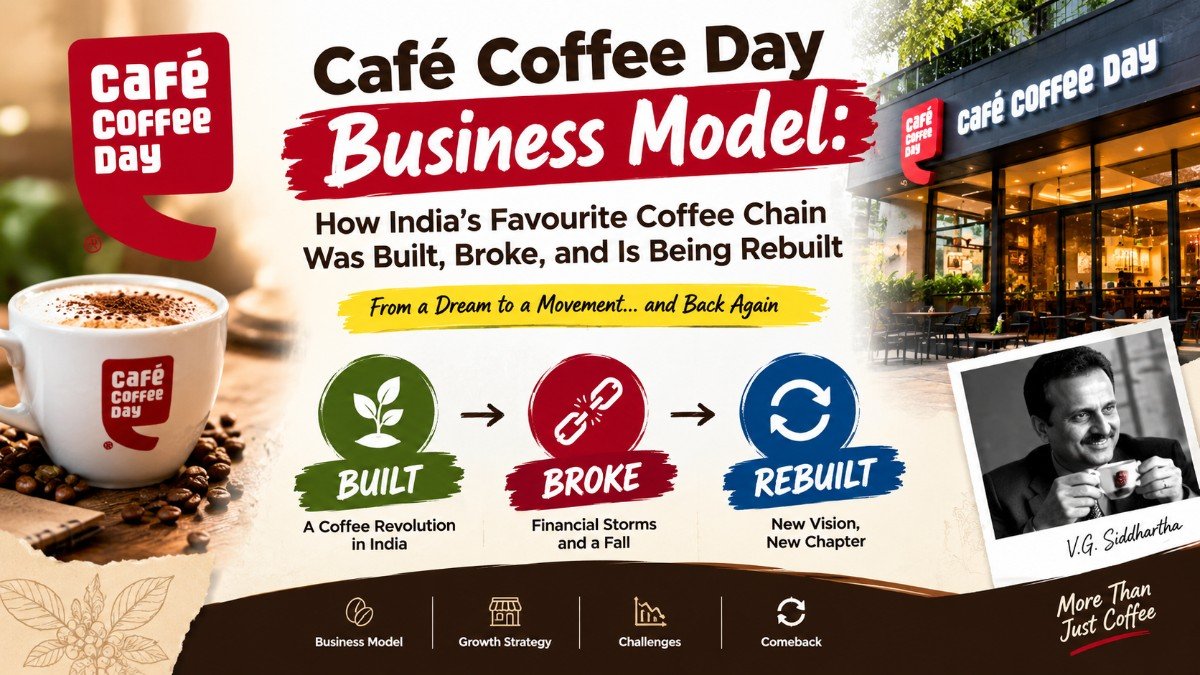
Café Coffee Day (CCD) isn’t just a coffee shop chain — for an entire generation of Indian college students and young professionals, it was the default answer to “where do we meet?” Built from scratch in 1996 and grown into India’s largest homegrown coffee chain, CCD’s story is as much about founder V.G. Siddhartha’s entrepreneurial vision as it is about the dangers of aggressive, debt-fuelled expansion.
This article breaks down how CCD’s business model actually worked, what made it different from global rivals like Starbucks, and how the brand is trying to rebuild after one of India’s most talked-about corporate crises.
A Quick Snapshot
| Founded | July 11, 1996 |
| Founder | V.G. Siddhartha |
| Headquarters | Bengaluru, Karnataka |
| Parent Company | Coffee Day Global Limited |
| Tagline | A Lot Can Happen Over Coffee |
| Peak Outlet Count | 1,750+ |
| Current Outlet Count | ~450 cafés across 141 cities |
| Business Model | Vertically integrated coffee chain |
How It All Began
CCD traces back to V.G. Siddhartha, a Mangalore University economics graduate who started his career in stock market trading before turning to his family’s coffee plantation roots. By the mid-1980s he had already built up a sizeable coffee estate business, and in 1993 he set up Amalgamated Bean Coffee Trading Company (ABCTCL) to export coffee internationally — a venture that soon made his firm one of India’s top coffee exporters.
The real leap came in 1996, when Siddhartha opened the first CCD outlet on Bangalore’s Brigade Road. At a time when India was overwhelmingly a tea-drinking nation, he bet that coffee could become a youth culture statement rather than just a beverage — a place to sit, talk, and hang out. That one outlet eventually grew into a nationwide chain of over 1,750 cafés at its peak.
The Business Model: Why CCD Was Different
The single biggest differentiator in CCD’s business model was vertical integration. Unlike most coffee chains that buy beans from external suppliers, CCD owned the entire value chain — its own coffee plantations spanning roughly 20,000 acres in Chikkamagaluru (making it one of Asia’s largest Arabica coffee growers), its own roasting and processing, its own vending machine manufacturing, and even the furniture used inside its outlets.
This gave CCD two major advantages:
- ●Cost control — owning the supply chain end-to-end kept prices significantly lower than international rivals.
- ●Quality consistency — controlling everything from bean to cup meant a predictable product across hundreds of outlets.
This integration is also why CCD could pursue an aggressive low-price strategy while competitors like Starbucks positioned themselves as premium.
The 3 Pillars of CCD’s Strategy: The “3 A’s”
- Affordability — Pricing accessible enough for students and young office-goers, not just premium urban consumers.
- Accessibility — An aggressive outlet expansion strategy aimed at making CCD available almost everywhere, including Tier 2 cities, not just metros.
- Acceptability — Creating a relaxed, youth-friendly “hangout” experience rather than just selling coffee, reinforced by its iconic tagline.
Marketing and Brand Building
CCD’s marketing leaned heavily into experience over product. A few standout moves:
- ●Digital-first engagement — an active social media presence and a dedicated app to personalize offers and enable cashless payments.
- ●Cashless partnerships — a 2016 tie-up with Freecharge let customers pay using just their mobile number, years before UPI became mainstream.
- ●Café Concerts — live music events launched in 2016 across Mumbai, Delhi, Pune, and Bengaluru, turning outlets into informal entertainment venues.
- ●Diversified sub-brands — formats like Coffee Day Square, Coffee Day Lounge, and Coffee Day Value Express targeted different segments and price points.
Distribution and Scale
At its peak around 2019, CCD operated roughly 1,750 outlets spread across 243 Indian cities, along with a presence in international markets including Austria, the Czech Republic, Malaysia, Dubai, and Egypt. Beyond cafés, the company also ran tens of thousands of coffee vending machines placed in corporate offices and hotels — a quieter but high-volume revenue stream that’s often overlooked in CCD’s story.
The Debt Crisis That Changed Everything
CCD’s rapid, capital-intensive expansion eventually caught up with it. By March 2019, the company had accumulated debt of roughly ₹6,550 crore. A global slump in coffee prices and a steep drop in Indian coffee exports only added pressure.
To raise cash, Siddhartha sold his entire stake in IT services firm Mindtree to L&T for around ₹3,200 crore — a company he’d held for nearly two decades. He was also reportedly in talks with Coca-Cola for a stake sale in CCD itself, and with Blackstone over his real estate venture. Around the same time, Income Tax Department raids across multiple cities added further strain, with authorities alleging unaccounted income.
The Turnaround: Rebuilding Under New Leadership
After Siddhartha’s death, his wife Malavika Hegde — an engineer with prior experience in the coffee business — took over as leader of the company in late 2020, inheriting debt of roughly ₹7,000 crore. Her turnaround strategy focused on a few clear priorities:
- ●Selling non-core assets, including a technology business park sold to Blackstone and Salarpuria Sattva for around ₹2,700 crore.
- ●Paying down lender debt, with around ₹1,644 crore repaid to 13 lenders.
- ●Shrinking the footprint strategically, closing underperforming outlets rather than chasing outlet count.
- ●Refocusing on the core coffee business, rather than spreading across too many verticals.
The results have been gradual but real. Net debt came down from around ₹2,910 crore in FY20 to roughly ₹1,731 crore by FY21, and the company reported a 10% rise in net revenue to around ₹1,013 crore for the year ending March 2024.
Where CCD Stands Today
CCD today operates around 450 cafés across 141 cities, supported by over 52,000 coffee vending machines placed in corporate and hospitality settings. Interestingly, the company’s revenue today isn’t purely café-driven:
|
Coffee Business
~47% |
Logistics Arm
~45% |
Hospitality
~8% |
That diversification has become an important cushion for the business as it continues working through residual debt obligations.
SWOT Snapshot
|
Strengths
Strong, well-recognized brand
Owns its own coffee plantations
Loyal, long-standing customer base |
Weaknesses
High legacy debt
Sharp reduction in outlet count
Ongoing financial pressure |
|
Opportunities
Expansion into Tier 2/3 cities
Growth in café delivery and vending
Premiumization of coffee culture |
Threats
Competition from Starbucks, Costa, Third Wave
Rising real estate and input costs
Shifting consumer preferences |
Key Business Lessons from the CCD Story
|
1 |
Vertical integration can be a genuine cost advantage — but it also ties up enormous capital in physical assets like land and machinery. |
|
2 |
Expansion speed and financial discipline must move together. Rapid outlet growth without matching cash flow discipline is what ultimately strained CCD. |
|
3 |
A strong brand alone can’t offset a broken balance sheet. Customer loyalty kept CCD alive, but it couldn’t erase its debt. |
|
4 |
Leadership continuity during a crisis matters enormously. Malavika Hegde’s structured, asset-sale-driven turnaround is a textbook example of stabilizing a company in free fall. |
|
5 |
Diversified revenue streams build resilience. CCD’s logistics and vending businesses have quietly become as important as its café chain. |
Conclusion
Café Coffee Day’s journey is a rare case study that combines genuine entrepreneurial breakthrough with a cautionary tale about debt-fuelled growth. It built something few Indian brands had managed before — a homegrown coffeehouse culture that out-expanded global giants in sheer footprint — while ultimately being undone by financial overreach rather than a failure of its core idea. Under new leadership, CCD is no longer chasing outlet counts; it’s chasing sustainability. Whether it can fully reclaim its old cultural dominance remains to be seen, but its story continues to be one of the most instructive business case studies to come out of India’s consumer sector.