The Humble Beginnings: How Two Brothers Changed Fast Food Forever
McDonald’s story began in 1940 when Richard and Maurice McDonald opened a simple drive-in restaurant at 1398 North E Street in San Bernardino, California. What started as a modest café would eventually revolutionize the entire food service industry. The McDonald brothers initially ran a traditional drive-in restaurant, but their innovative spirit led them to something much bigger.
In 1948, the brothers introduced the groundbreaking “Speedee Service System,” transforming their restaurant into something the world had never seen before. They streamlined their menu to just burgers, fries, and shakes, eliminated waiters and plates, and created an assembly-line approach to food preparation that could deliver orders within 2 minutes. This revolutionary concept laid the foundation for modern fast food.
The Ray Kroc Revolution: Turning Vision into Reality
The McDonald’s story took a dramatic turn in 1954 when Ray Kroc, a 52-year-old milkshake mixer salesman, arrived at the San Bernardino location. Kroc had come to investigate why the McDonald brothers needed eight milkshake mixers for a single restaurant. What he witnessed changed everything: endless lines of customers eagerly waiting for their orders.
Despite being in his fifties and having faced multiple career failures as a musical director, pianist, real estate agent, and kitchen appliance salesman, Kroc saw an unprecedented opportunity. He convinced the McDonald brothers to embrace a franchise model and took on the challenge with remarkable determination. In his first year, Kroc mortgaged his house and opened 18 new outlets, demonstrating the scalability of the McDonald’s concept.
The partnership between Kroc and the McDonald brothers eventually soured due to differing visions for expansion. While the brothers were content with their comfortable lifestyle, Kroc had grander ambitions. In 1961, he borrowed money to buy out the McDonald brothers for $2.7 million, becoming the sole owner of McDonald’s Corporation.
Building an Empire: McDonald’s Explosive Growth Journey
Under Ray Kroc’s leadership, McDonald’s experienced phenomenal growth that seemed almost impossible. The company’s expansion was so rapid that at one point, McDonald’s was opening a new outlet every 14.5 hours. This aggressive growth strategy transformed McDonald’s from a single restaurant into a global phenomenon.
Today, McDonald’s operates over 39,000 restaurants across more than 120 countries, serving approximately 69 million customers daily. The company serves over 2.3 billion burgers annually and has become the fourth-largest employer in the world. Remarkably, McDonald’s has also become the world’s largest toy distributor, primarily through its Happy Meal program.
The company’s international expansion began in 1967 with outlets in Canada and Puerto Rico. By 2018, McDonald’s had established its presence in 120 countries with approximately 37,200 restaurants and 1.9 million employees worldwide.
The Golden Arches: Evolution of an Iconic Brand
McDonald’s visual identity has undergone significant evolution since its inception. The first mascot was “Speedee,” a cooking cap perched on a burger. In 1962, the now-famous Golden Arches replaced Speedee as the universal symbol of McDonald’s. The iconic clown mascot, Ronald McDonald, was introduced in 1965 to appeal specifically to children.
The Golden Arches logo, featuring the distinctive double-curved “M,” wasn’t trademarked until November 18, 1968. Before this design, McDonald’s used a single arch in their restaurant architecture. This simple yet memorable logo has become one of the most recognizable symbols worldwide, representing not just fast food but American culture and globalization itself.

Revolutionary Business Model: More Than Just Burgers
McDonald’s success isn’t solely based on selling food; it’s built on a sophisticated business model that generates revenue through multiple streams. The company’s primary income comes from rents and fees paid by franchisees, making McDonald’s essentially a real estate company disguised as a restaurant chain.
The franchise model allows McDonald’s to expand rapidly with minimal capital investment while maintaining consistent quality and brand standards across all locations. This approach has enabled the company to achieve a valuation of over $185 billion, making it the world’s largest restaurant chain by revenue.
McDonald’s operates through three main segments: company-owned restaurants, franchised restaurants, and developmental licensing. This diversified approach provides stability and growth opportunities across different markets and economic conditions.
Menu Innovation: Adapting to Changing Consumer Tastes
While McDonald’s built its reputation on burgers, fries, and shakes, the company has continuously evolved its menu to meet changing consumer preferences. In response to growing health consciousness and criticism about food quality, McDonald’s has expanded its offerings to include salads, fish, smoothies, and fresh fruits.
The company has introduced various breakfast items, chicken products, wraps, and desserts to appeal to different demographics and meal occasions. McDonald’s has also embraced local tastes in international markets, offering unique menu items that cater to regional preferences while maintaining its core identity.
Recent developments show McDonald’s commitment to value with the launch of the McValue platform in January 2025, featuring “more fan-favorite items and even more ways to save” for customers nationwide.
Global Expansion Strategy: McDonaldization of the World
McDonald’s international expansion strategy, often referred to as “McDonaldization,” represents one of the most successful globalization efforts in business history. The company’s success in over 120 countries can be attributed to its flexible organizational structure that allows for localization while maintaining core brand values.
McDonald’s adapts its business model to suit local markets, customs, and regulations. This approach has enabled the company to thrive in diverse cultural and economic environments. The hierarchical structure allows for local adaptation while ensuring consistency in quality, service, and brand experience.
The company divides its global operations into four segments: U.S. market, International Lead Markets (Australia, Canada, France, Germany, and the U.K.), High Growth Markets (China, Italy, Korea, Poland, Russia, Spain, Switzerland, and the Netherlands), and Foundational Markets and Corporate Operations.
Technology and Innovation: Embracing the Digital Future
McDonald’s has embraced technological innovation to enhance customer experience and operational efficiency. The company has invested heavily in digital technologies, including mobile ordering, delivery platforms, and self-service kiosks. These innovations have helped McDonald’s stay competitive in an increasingly digital marketplace.
The company has announced “ambitious new growth targets to advance its Accelerating the Arches strategy”, focusing on development, loyalty membership, and cloud technology. This digital transformation is essential for maintaining relevance with younger consumers and improving operational efficiency.
The introduction of services like McCafé, McDrive, and various digital ordering platforms demonstrates McDonald’s commitment to innovation and customer convenience.
Corporate Social Responsibility: Beyond Profit
McDonald’s has increasingly focused on environmental sustainability and social responsibility. The company has set ambitious goals for sustainable packaging, aiming to source all guest packaging from renewable, recycled, or certified sources by 2025.
McDonald’s became the first restaurant company to set an approved science-based target to reduce greenhouse gas emissions. The company has also committed to recycling guest packaging in 100% of restaurants and overcoming infrastructure challenges by 2025.
Through initiatives like McHappy Day, which supports Ronald McDonald House Charities, and various community engagement programs, McDonald’s demonstrates its commitment to giving back to the communities it serves.
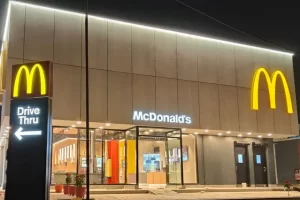
McDonald’s financial performance has been consistently strong, making it an attractive investment for shareholders. The company has increased shareholder dividends for 25 consecutive years, earning it a place among the S&P 500 Dividend Aristocrats. McDonald’s is ranked 131st on the Fortune 500 list of largest United States companies by revenue.
Recent financial results show McDonald’s continuing focus on “growing market share” with CEO Chris Kempczinski noting they’re “playing to win, focusing on our customers with outstanding value, exciting menu innovation and culturally relevant marketing.”
The company’s revenue streams from franchising provide stability and predictable cash flow, making McDonald’s an attractive long-term investment despite occasional quarterly fluctuations.
Challenges and Adaptations: Staying Relevant in Changing Times
Despite its success, McDonald’s faces ongoing challenges including changing consumer preferences toward healthier options, increased competition from fast-casual restaurants, and economic pressures in various markets. The company has responded by diversifying its menu, improving food quality, and enhancing the customer experience.
Recent challenges include same-store sales falling globally by 1.5%, demonstrating the competitive pressures facing the fast-food industry. However, McDonald’s continues to adapt through value offerings and menu innovations.
The company has also addressed criticism about employee wages and working conditions by implementing various employee support programs and educational opportunities through initiatives like McDonald’s Hamburger University.
The Future of McDonald’s: Innovation and Sustainability
Looking ahead, McDonald’s is positioning itself as a leader in sustainable business practices and technological innovation. The company has announced significant changes coming in 2025, including “exciting new menu launches” and “improved affordability.”
McDonald’s future strategy focuses on three key areas: retaining existing customers, regaining lost trust, and converting casual customers into regular ones. The company has embraced three accelerators to drive growth: digital technology, food delivery, and enhanced customer experience.
The company’s commitment to environmental sustainability, combined with its focus on technological innovation and customer experience, positions McDonald’s well for future growth. As consumer preferences continue to evolve, McDonald’s proven ability to adapt while maintaining its core brand identity suggests the Golden Arches will remain a dominant force in the global food service industry for years to come.
Conclusion: The Enduring Legacy of the Golden Arches
McDonald’s remarkable journey from a modest drive-in restaurant in San Bernardino to a $185+ billion global empire stands as one of the most extraordinary success stories in modern business history. What began with Richard and Maurice McDonald’s simple vision of fast, efficient service was transformed by Ray Kroc’s entrepreneurial genius into a worldwide phenomenon that has fundamentally changed how the world eats.