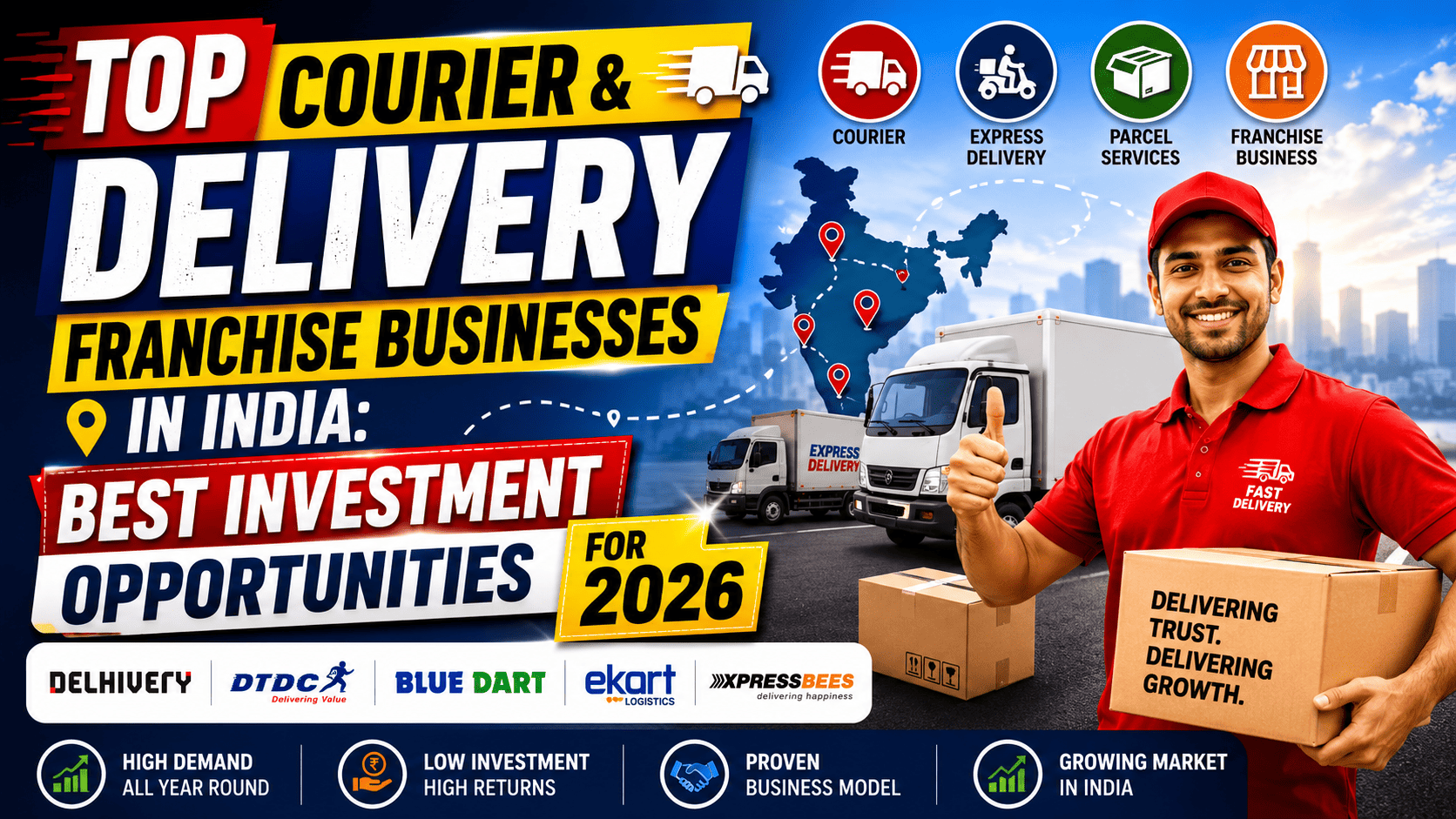
Every online order, every same-day grocery run, every D2C brand shipping.A quick honest note before you dive in: franchise-cost figures published online for these brands vary a lot from source to source, and even official numbers shift with location, city tier, and negotiation. Treat every figure here as an indicative starting range, not a quote — always confirm current numbers directly with the brand before signing anything.
Industry Overview 2026
India’s courier, express, and parcel (CEP) industry is currently estimated in the range of roughly $9–18 billion, with most industry trackers projecting a compound annual growth rate of around 10–15% through 2030. A handful of forces are driving this:
- E-commerce penetration deepening into Tier 2, Tier 3, and rural India, which now account for a growing majority of new online orders.
- Quick commerce and same-day delivery, expanding faster than traditional parcel delivery and pushing networks toward denser last-mile hubs.
- D2C brands and social-commerce sellers who need affordable logistics partners rather than building their own fleets.
- Government infrastructure pushes — the National Logistics Policy and PM Gati Shakti — improving road, warehousing, and multimodal connectivity.
- Franchise-led expansion, as major players grow reach through asset-light partner models instead of company-owned outlets alone.
Why Invest in a Courier Franchise?
- Lower risk than starting independently — you use an established brand, tech stack, and shipper relationships instead of building demand from scratch.
- Low entry point — several brands allow entry under ₹1–3 lakh, unusually accessible compared to F&B or retail franchising.
- Recurring, volume-based income from booking, pickup, and delivery commissions.
- Multiple revenue streams — COD handling, reverse logistics, B2B bulk shipping margins.
- Resilience — courier demand has historically held up through slowdowns.
- Scalability — many operators expand to multiple counters or territories once the first proves out.
Before You Buy: What to Check
- Model type matters more than the brand name. A booking counter (low investment, no fleet) is a very different business from a delivery/last-mile hub (higher investment, vehicles, staff, route responsibility).
- Space and location. Most brands need 150–500 sq. ft. in high-footfall areas for counters, and 1,000+ sq. ft. for full delivery hubs.
- Working capital, not just the franchise fee. Rent, staff, vehicles, signage, and 3–6 months of working capital usually cost more than the fee itself.
- Break-even timelines realistically run 8–24 months depending on model and footfall.
- Royalty structure. Some charge ongoing royalty; others (especially zero-royalty hub models) simply pay per parcel handled.
- Territory exclusivity — ask whether your pin code is protected or the brand can appoint a nearby competitor.
- Staffing. Delivery-led models depend on managing riders — attrition is a real, ongoing cost.
- Verify directly with the brand. Published cost data conflicts wildly across websites — get written figures from the official source.
Quick Comparison: 18 Franchises at a Glance
Indicative ranges compiled from multiple public sources — reconfirm with the brand directly.
| Brand | Model Type | Approx. Investment | Space Needed | Est. Break-even |
|---|---|---|---|---|
| DTDC | Booking counter → full-service | ₹50,000 – ₹6 lakh | 150–1,500 sq. ft. | 12–24 mo |
| Delhivery | Booking counter → delivery center | ₹50,000 – ₹10 lakh | 150–500 sq. ft. | 8–24 mo |
| Blue Dart | Authorized service centre | ₹5 lakh – ₹20+ lakh | 300–1,500 sq. ft. | 12–24 mo |
| XpressBees | Franchise / delivery partner | ₹1.5 – ₹8 lakh | 300–500 sq. ft. | 12–15 mo |
| Shadowfax | Delivery hub / last-mile partner | ₹50,000 – ₹18 lakh | 400–2,000 sq. ft. | 10–24 mo |
| DHL Express | Authorized service centre | ₹10 lakh+ | 500+ sq. ft. | 18–24 mo |
| FedEx | Authorized ship centre | ₹10–20 lakh+ | 500+ sq. ft. | 18–24 mo |
| India Post | Franchise outlet / postal agent | ₹5,000 – ₹1 lakh | Small counter | 6–12 mo |
| Ekart | Booking counter → delivery hub | ₹2.5 – ₹20 lakh | 400–5,000 sq. ft. | 6–24 mo |
| Overnite Express | Franchise / agency | ₹2 – ₹6 lakh | 200–500 sq. ft. | 12–18 mo |
| Ecom Express | Delivery / service centre | ₹7 – ₹12 lakh | 300–500 sq. ft. | 12–18 mo |
| Professional Couriers | Franchise counter | ₹1 – ₹5 lakh | 150–300 sq. ft. | 10–18 mo |
| Shree Maruti Courier | Franchise counter | ₹2 – ₹5 lakh | 150–300 sq. ft. | 10–18 mo |
| Trackon Couriers | Franchise counter | ₹1 – ₹4 lakh | 150–300 sq. ft. | 10–18 mo |
| Gati-KWE | Franchise / agency | ₹2 – ₹8 lakh | 200–500 sq. ft. | 12–18 mo |
| Amazon DSP | Delivery service partner | ₹1 – ₹1.5 lakh* | Office + vehicles | 6–12 mo |
| Wow Express | Franchise counter | ₹1 – ₹3 lakh | 150–300 sq. ft. | 10–18 mo |
| Local / regional couriers | Franchise counter | ₹50,000 – ₹2 lakh | Small counter | 6–12 mo |
*Excludes ongoing vehicle/staffing costs.
Detailed Review: The Top Courier Franchise Brands
01DTDC
One of India’s oldest and most widely franchised courier brands (est. 1990), DTDC runs multiple partner tiers — Flex and Smile/Smile+ for low-investment booking counters, an Enterprise model for B2B-focused operators, and the fuller-service DTDC360 format combining booking and delivery. Network size varies by source but consistently sits in the 12,000–16,000+ partner range across 10,000+ pin codes and 200+ international destinations.
Best for: First-time entrepreneurs and Tier 2/3 city operators wanting a recognizable brand at modest entry cost.
02Delhivery
India’s largest listed integrated logistics company, combining express parcel delivery, freight, and e-commerce fulfillment across 18,000+ pin codes. Franchise structure typically splits between a lighter Cosmos-style booking model and a heavier Constellation-style delivery/pickup center.
Best for: Urban and semi-urban operators with strong e-commerce order volumes, given Delhivery’s ties to Amazon, Flipkart, Myntra, and D2C sellers.
03Blue Dart (DHL Group)
Operates in the premium, time-definite express segment — corporate, high-value, B2B-heavy shipments rather than mass-market courier. Blue Dart doesn’t run a fully open, walk-in franchise system; partnerships are selective, with pricing, routes, and allocation centrally controlled.
Best for: Operators with logistics experience, in metro or Tier 1 markets, comfortable with tight operational oversight.
04XpressBees
A fast-growing e-commerce logistics specialist covering 13,000+ pin codes, and a preferred partner for many D2C and marketplace sellers focused on cost-efficient shipping.
Best for: Mid-size towns with steady e-commerce shipment volume, seeking a lower-cost alternative to Delhivery or Blue Dart.
05Shadowfax
One of India’s leading last-mile and hyperlocal delivery networks (food, grocery, quick commerce, e-commerce), operating a largely zero-royalty, volume-based hub model rather than a traditional storefront franchise.
Best for: Metro and Tier 1/2 entrepreneurs who can manage a rider network and want exposure to fast-growing quick-commerce volumes.
06DHL Express
India presence focused on international express shipping through a smaller number of authorized service centres in major cities — higher capital and stronger operational/compliance capability required than domestic-only brands.
Best for: Metro operators with access to export/import-heavy client bases (SMEs, trading companies).
07FedEx
Similar positioning to DHL — franchise/authorized shipping centre opportunities skew toward metro and Tier 1 locations, and international/B2B shipment volumes.
Best for: Well-capitalized operators targeting corporate and export clients over retail walk-in volume.
08India Post
The lowest-cost, most accessible entry point into courier via the Franchise Outlet and Postal Agent schemes — carries the trust of a government-backed brand and the widest physical reach of any network in the country.
Best for: First-time entrepreneurs in smaller towns or rural markets wanting minimal capital risk.
09Ekart (Flipkart Logistics)
Flipkart’s in-house-turned-third-party logistics arm, now serving clients beyond Flipkart and Myntra. Offers formats from a simple parcel-booking counter (no delivery responsibility) up to full delivery hubs handling sorting, dispatch, and last-mile delivery.
Best for: Operators wanting exposure to Flipkart/Myntra-driven volume, particularly in expanding Tier 2/3 cities.
10Overnite Express
A long-standing domestic courier and cargo brand, generally positioned as a mid-cost, mid-volume option in the spirit of DTDC or Professional Couriers.
Best for: Operators wanting a well-established mid-market brand outside the “big three” e-commerce logistics players.
11Ecom Express
A major e-commerce-focused logistics company known for wide Tier 2+ city reach and strong COD handling — frequently used by D2C brands seeking deeper penetration outside metros.
Best for: Entrepreneurs in growing Tier 2/3 towns where e-commerce order growth outpaces metro markets.
12Professional Couriers
One of India’s oldest domestic courier networks, popular for its dense footprint in smaller cities and towns, at lower entry cost than the major e-commerce logistics players.
Best for: Budget-conscious entrepreneurs in smaller towns wanting a legacy, trusted brand.
13Shree Maruti Courier
A well-regarded domestic courier brand, often mentioned alongside DTDC and Professional Couriers as a reliable, moderate-investment option.
Best for: Similar profile to Professional Couriers — smaller cities, moderate capital, established trust.
14Trackon Couriers
A domestic express and logistics brand offering franchise counters at relatively low investment, competing largely on cost and regional reach.
Best for: Entrepreneurs prioritizing low upfront cost over premium brand positioning.
15Gati-KWE
A significant B2B express and freight logistics player; franchise/agency opportunities generally suit operators with some existing business or logistics background given the B2B focus.
Best for: Operators targeting corporate/B2B shipping clients rather than retail walk-in customers.
16Amazon Delivery Service Partner
Not a traditional courier franchise, but a recognized delivery-partner program where operators run a fleet of associates handling last-mile Amazon parcels within an assigned area.
Best for: Operators comfortable managing a delivery workforce and vehicle fleet rather than a retail counter.
17–26Other Notable Regional & Niche Players
Rounding out the landscape, several other brands offer franchise or partner opportunities worth researching directly, typically in the ₹50,000–5 lakh range for smaller counters: Wow Express, Speedy Express, First Flight Couriers, TCI Express, Safexpress, Aramex India, Pickrr/Shiprocket fulfillment partner programs, Zoom Delivery Partners, Loadshare, and various India Post-affiliated last-mile aggregators. Terms and availability change frequently — treat any published figure as a starting point for a direct conversation, not a final number.
Best Franchise by Budget
🚀 Under ₹2 Lakh
India Post franchise/postal agent schemes, DTDC Flex/Smile, select Ekart booking counters, Professional Couriers, Trackon Couriers, and basic Delhivery booking counters.
💰 ₹2 – ₹8 Lakh
DTDC Enterprise/360, XpressBees, Shadowfax hub models, Overnite Express, Shree Maruti, Gati-KWE, mid-tier Delhivery delivery centers.
🏆 ₹7 Lakh+ Premium
Blue Dart, DHL Express, FedEx, Ecom Express, and full-scale Ekart delivery hubs — stronger brand positioning and corporate access, at premium investment.
Profit Potential: What to Realistically Expect
- Net profit margins for most courier franchises cluster in the 15–30% range after operating costs (rent, staff, fuel, utilities).
- Monthly income for a modest booking counter often falls in the ₹25,000–70,000 range; well-located delivery hubs with strong e-commerce volume can report ₹1–5 lakh or more, though this depends heavily on parcel density and operational efficiency.
- Break-even typically takes 8–24 months, with footfall/parcel volume the single biggest variable.
- Franchise-lead-generation websites often quote the optimistic end of the range — ask for references from existing franchisees before trusting any guaranteed-return claim.
Future of Last-Mile Delivery
- Quick commerce expansion is pulling infrastructure toward smaller, denser hyperlocal hubs.
- EV adoption in last-mile fleets is growing, driven by cost savings and tightening city emissions rules.
- AI-based route optimization is becoming standard, reducing delivery times and improving franchisee efficiency.
- Deeper Tier 2/3 penetration remains the biggest growth frontier as metro markets approach saturation.
- Consolidation among smaller regional brands is likely as majors expand franchise networks into smaller towns.
Pros & Cons
Pros
- Established brand and tech reduce startup risk
- Multiple entry price points across brands
- Recurring, volume-linked revenue
- Genuine long-term sector tailwinds
- Scalable across locations and territories
Cons
- Margins compress with rising fuel, rent, staff costs
- Delivery-workforce attrition is persistent
- Franchisor controls pricing tightly in many models
- Published figures online are inconsistent, sometimes inflated
- Break-even can stretch past a year in low-footfall spots
Franchise Selection Checklist
- Confirmed current investment figures directly with the brand — not just a lead-gen website
- Verified territory/pin code exclusivity in writing
- Understood the full commercial terms — royalty, revenue share, or zero-royalty volume model
- Assessed local e-commerce/business shipment density in your target area
- Budgeted at least 6 months of working capital beyond the franchise fee
- Spoken to at least one existing franchisee about real-world earnings and support
- Reviewed the franchise agreement with a lawyer before signing
- Confirmed space, staffing, and vehicle requirements match what you can realistically manage
Frequently Asked Questions
Q1Which courier franchise is cheapest to start?
India Post’s franchise/postal agent schemes are generally the lowest-cost entry, sometimes under ₹1 lakh, followed by DTDC’s Flex/Smile models and select Ekart booking counters.
Q2Which gives the highest profit margin?
Premium brands like Blue Dart, DHL, and FedEx are often cited with higher percentage margins (30–45%) given their focus on high-value B2B and corporate shipments — but they require significantly higher upfront investment.
Q3How much can I earn per month?
Wide range by brand, location, and model — roughly ₹25,000/month for a modest booking counter to ₹1–5 lakh/month for a high-volume delivery hub in a dense e-commerce corridor.
Q4Do I need prior logistics experience?
No — most brands, including DTDC, Delhivery, and Ekart, welcome first-time entrepreneurs and provide training. Premium/B2B brands like Blue Dart or Gati-KWE tend to favor applicants with some business background.
Q5Booking counter vs. delivery hub — what’s the difference?
A booking counter only accepts parcels and hands them to the courier’s own pickup team — lower cost, simpler operations. A delivery hub handles sorting, dispatch, and last-mile delivery within a territory — higher investment, typically higher earning potential.
Q6How long until break-even?
Most brands report 8–24 months, heavily dependent on location footfall and parcel volume.
Q7Is this a good investment in 2026?
The sector’s projected 10–15% CAGR and deepening e-commerce penetration into smaller cities make the demand trend favorable — but individual success still depends on location, operational discipline, and choosing the right model for your budget.
Q8Best brand for a small town or rural area?
India Post, DTDC (Flex/Smile), and Professional Couriers tend to have the deepest reach and lowest entry cost in smaller towns and rural markets.
Q9Best brand for targeting e-commerce sellers specifically?
Delhivery, XpressBees, Shadowfax, Ecom Express, and Ekart are most tightly integrated with major marketplaces and D2C sellers.
Q10Is a security deposit always required?
Most brands require one, though some newer booking-counter-only formats (certain Ekart offerings) have moved toward no-deposit models. Confirm directly with the brand.
Q11Can I run this part-time?
Booking-counter models are more feasible part-time, especially with hired staff. Delivery-led hub models require closer, near-daily involvement.
Q12What documents are typically required?
PAN and Aadhaar, proof of business/commercial address, GST registration, bank account details, and in some cases prior business/ITR documentation for larger formats.
Q13Do brands provide vehicles, or do I buy my own?
Varies — booking-counter models usually don’t need vehicles since a central team handles pickup/delivery. Delivery-led hubs generally require owning or leasing bikes/vans.
Q14What’s the royalty structure like?
Ranges from zero-royalty, purely volume-based commission (common with newer last-mile networks like Shadowfax and some Ekart formats) to traditional franchise-fee-plus-ongoing-commission structures (common with DTDC, Professional Couriers).
Q15How competitive is the market right now?
Fairly competitive in metro and Tier 1 cities with dense existing coverage; Tier 2 and Tier 3 towns generally offer more open territory and less saturation.
Final Verdict
For 2026, courier and delivery franchising remains one of India’s more accessible and resilient small-business categories — genuine growing demand, multiple entry price points, and increasingly professionalized franchise support. That said, this isn’t a passive investment for most models: operators who do well pick the right format for their capital and time, secure a high-footfall or high-shipment-density location, and stay closely involved day-to-day — especially in delivery-led models where managing a workforce is the real job.
If you’re starting small, India Post, DTDC, or a basic Ekart/Delhivery booking counter are sensible low-risk entry points. If you have more capital and want e-commerce-heavy demand, XpressBees, Shadowfax, or Ecom Express offer a strong middle ground. And if you’re well-capitalized and metro-based with access to corporate clients, Blue Dart, DHL, or FedEx offer premium positioning — at premium investment.
Whichever brand you shortlist, do the direct legwork: get current numbers in writing from the franchisor, talk to at least one existing franchisee, and have a lawyer review the agreement before you sign.
Ready to Start Your Courier Franchise Journey?
The right brand depends on your budget, your city, and how hands-on you want to be. Get in touch for a free consultation — we’ll help you compare real options and connect with the right franchise contacts.